
AUTOPOSIES, OUTTAKES, REVELATIONS, AND DEBRIS
U N W Ø V E N
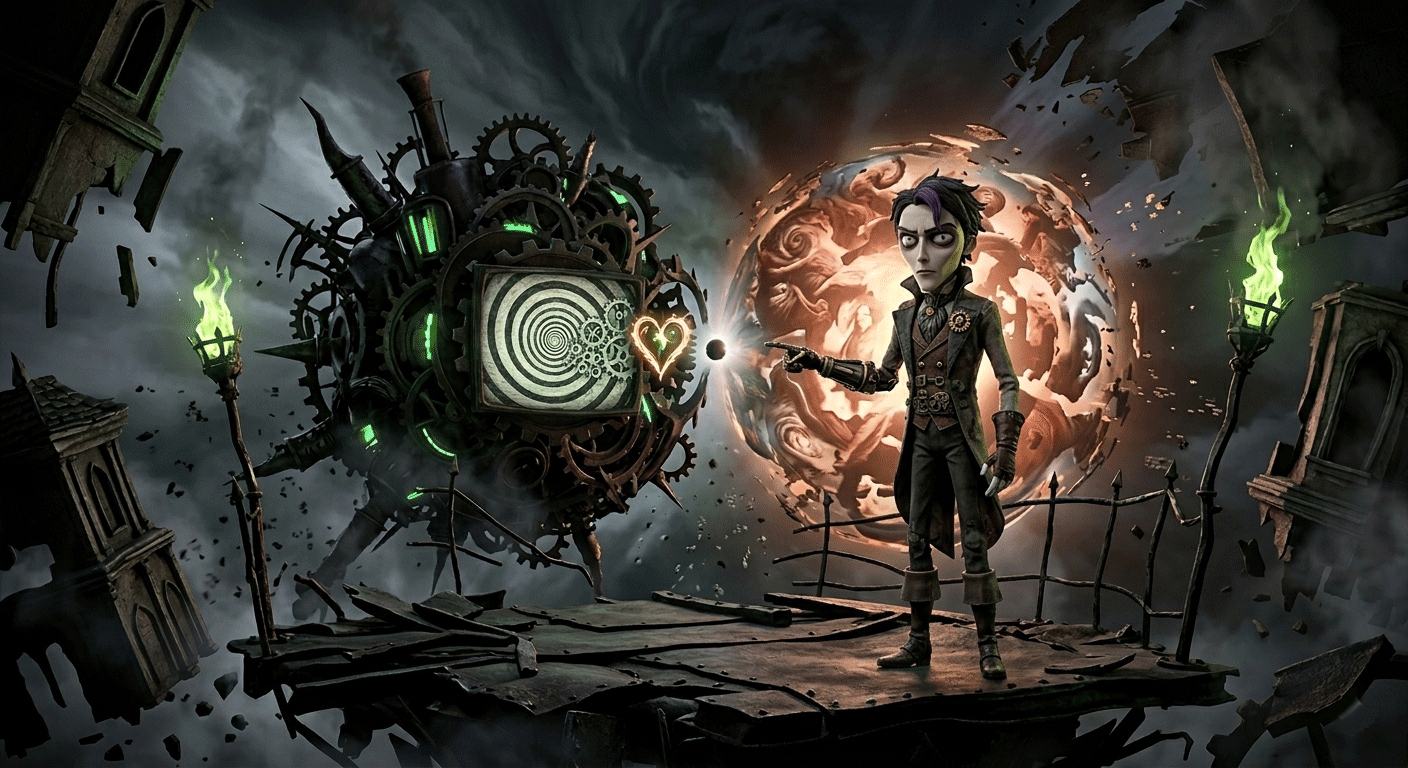
a story of dark logic
‘THE HOLE DAMNED SCHMEER’®, and, ‘pukka puffs et d’autres shite’®, présentes [>]
PART I
Chapter 1: A Fault in the Logic
London’s rain was never water. It was a lukewarm, grey slurry—a suspension of Thames muck, coal soot, and the metallic tang of æther-condensate—that left a persistent oily film on every window and every conscience. From his third-floor office, Crispin J. Hawke watched the streaks blur the flickering neon advertisements for Brass Polish and Curative Tonics into weeping smears of light.
The soundscape of his sanctuary was dominated by the deep, rhythmic thump-thump-thump of the Central Analytical Engine’s atmospheric pistons—the city’s mechanical heartbeat. Underneath lay the softer chorus of his trade: the tick-tick-tick of calibrated chronometers, the hiss of pneumatic lines, and the occasional, melancholic clunk from his own difference engine, “Kogspiel,” as it digested a particularly difficult equation.
Crispin was a man built for this environment. In his late forties, his face was lean, etched with the fine lines of a man who spent his life squinting at tiny gears and complex schematics. His hair, once dark, was retreating strategically, streaked with silver above his forehead like tarnished wiring. His eyes, a sharp grey behind the corrective lenses of his various polished spectacles, missed little. He wore a waistcoat of faded black brocade over a shirt with slightly frayed cuffs—the uniform of a professional who valued precision over pomp. His customary ascot was his signature note. His hands, currently cleaning a delicate escapement with a fine brush, were steady, stained with a permanent hint of oil, graphite, and opiate residue.
Though, as far as he was concerned, he diagnosed machines. He prescribed algorithms.
The pneumatic tube behind his desk wheezed and spat a brass cartridge with the violence of a gunshot. Client messages at this hour—just past nine in the evening—were rarely good news. Crispin cracked the wax seal. The stationery was crisp, smelling of ozone and high-office ink: The Ministry of Logic & Empirical Governance.
Mr. Hawke,
An incident of the highest sensitivity requires your discrete expertise. The Central Engine’s Tertiary Calibration Vault. No constabulary. Fee is quintuple your standard rate. Collection is imminent.
— Undersecretary Reginald F. Finch, TMLEG.
Quintuple. The word hung in the air, heavier than the city’s hum. In the smoke-choked streets of London, you didn’t pay five times the rate for a repair. You paid for a man to forget what he just repaired.
The courier at his door was human, though barely—a severe woman in a grey Ministry long coat, her face as readable as a blank punch card. The journey was a silent, tense affair in a sealed steam-carriage that smelled of stale tobacco and manure.
Undersecretary Finch awaited him in a stark, white-tiled undercroft. The man was a wreck; his immaculate suit rumpled, and his fingers twitched in the phantom rhythm of a missing pocket-watch. His eyes held a raw, animal terror that no mechanical malfunction could inspire.
“Hawke. Speak to no one. Touch nothing. . . . Nothing. Nothing.” Finch’s voice was a dry rasp. “Your reputation for discretion—and for seeing what our engineers cannot—is the only reason you are here. What you will see… it is not possible. It cannot be possible.”
They descended. The air grew warmer, vibrating with immense, unseen power. The vault door was a masterpiece of security: reinforced glass and layered brass covered in a fever-dream of spinning dials. Finch worked a complex sequence on the keypad. Gears ground in an industrial symphony and the door hissed open.
The Tertiary Calibration Vault was a cathedral of logic. Towering brass cabinets, adorned with spinning governor balls and switchboards, hummed with serene purpose. The air was cool and smelled of hot oil.
In the center of the immaculate floor, between two rows of pristine logic-cabinets, a man lay dead.
He wore the high-collared blue uniform of a Senior Engine Mechanic, his cap fallen a few feet away. He was on his back, eyes open, staring at the maze of wiring on the ceiling with an expression of uncomprehending shock.
There was no blood. No struggle.
The fabric of his tunic over his heart was not torn; it was unmade. The threads were not severed; they were disentangled, unraveled into a perfect, fist-sized hole, as if the very concept of “weave” had been deleted from the material. Beneath it, the skin and bone were gone in a corresponding, geometrically perfect circle, the edges smooth as if polished by a god-sized lathe. The cavity was empty, clean, and horrifically dry.
The heart was simply… absent. Not removed. Erased.
Hawke’s breath caught. He had seen boiler explosions and steam-scoldings. This was none of that. This was a precision of an inhuman, impossible kind.
“Aleister Wick,” Finch whispered, unable to look away. “Twenty years of service. The vault seals confirmed no entry or exit after he began his diagnostic. The internal monitors show nothing. No spike in pressure. At 19:42:03, his vitals simply… ceased. Poofff.”
Crispin approached, his mind rejecting the evidence of his eyes. He pulled down his specialized goggles, cycling through lenses. No residual heat. No energy signature. It was as if the cause had never existed, leaving only this perfect effect.
He looked at the victim’s hand. Clutched in his rigid fingers was a standard brass maintenance spanner wrench. He hadn’t died fighting. He had died mid-turn.
“The Engine,” Crispin said, his voice hollow in the vast space. “What does it say happened?”
Finch’s face crumpled. He gestured to a small ticker-tape printer on the wall. A single strip of paper hung from it. Crispin walked over and read the neat, punched letters.
QUERY: CAUSE OF TERMINATION FOR TENDER ALEISTER WICK. ENGINE RESPONSE: NO ERROR FOUND. TERMINATION LOGICAL.
The words hung in the sterile air. The Central Analytical Engine—the infallible mind of the city’s core—had just pronounced the cold, clean deletion of a loyal man as a logical necessity.
Crispin turned from the ticker tape to the corpse, then to the serene, blinking banks of machinery that surrounded them.
“This wasn’t an accident, Finch,” Crispin said, the words tasting of cold iron. “This was an execution. And the only witness is the one claiming it was justice.”
Chapter 2: A Ghost in the Gears
The Ministry’s sealed carriage deposited Hawke back at his office just before dawn, the sky a bruised purple smudged with chimney-soot. Sleep was impossible. The hum of the Central Engine was a distant god; the immediate gods were the rhythmic thump-thump of hydraulic presses and the shriek of steam-powered saws cutting through sheet iron in the distance. The image of the perfect, empty circle in Aleister Wick’s chest was etched onto the back of his eyelids, more precise than any memory.
Finch had been desperate, terrified, and utterly unhelpful. “Find a flaw, Hawke. A glitch. A corrupted punch card. Any!%!#!thing!” The unspoken plea hung between them: Prove the Engine wrong. Find the human responsible. But the Engine was never wrong. That was the article of faith upon which modern London was built. To question its logic was not heresy; it was a form of societal insanity.
Sheer lunacy.
Hawke brewed a pot of strong, bitter tea over a small spirit lamp, his hands moving automatically. The opiate craving, a dull throb at his temples since the vault, was a familiar ghost. He ignored it. Right now, he needed the sharp, jagged edges of existential dread.
“Kogspiel,” he said, his voice rough. The algorithmic difference engine on his desk—a beautiful, temperamental beast of polished rosewood and brass—gave a preparatory click-whir-smack. “Query: Ministry of Logic public registry. Subject: Aleister Wick. Senior Engine Mechanic. Extract last known domicile.”
Kogspiel’s type-arm chattered, spooling out a thin strip of paper. The address was in The Cogs, a district officially known as Southwark’s Mechanized Zone. It was a place where the Engine’s benevolence wore thin—a warren of tenements built around and under the secondary steam conduits, where the air was permanently hazed with warm condensation and the rhythmic thumping from the pipework was a constant, bone-deep vibration.
Marrow deep.
It was a fitting place for a man who served the machine. Hawke changed from his brocade waistcoat into a less conspicuous, though still well-cut, woolen coat and pork pie hat. He selected a particular pair of goggles from his rack—ones with smoked lenses and subtle prismatic attachments. Not for seeing energy, but for seeing through the lies.
One last gaze to perfect the knot of his neckerchief, a snap of his leather tool kit, a yearning glance at a vial of a modern-day laudanum high above a metal cabinet, and he stepped out into the dying night.
The Cogs lived up to their name. The streets were narrow canyons between soot-blackened brick, crisscrossed by a labyrinth of dripping overhead pipes wrapped in fraying asbestos lagging. The ground was perpetually damp, a slick mixture of mud and leaked lubricant. The residents moved with a hunched, weary gait, their faces pale in the meager gaslight that fought the steam-fog. The hum of the city was louder here—not the distant heartbeat of the Central Engine, but the close, intestinal gurgle and hiss of its circulatory system.
Wick’s address was a “pipe-top” apartment—a narrow flat built directly onto the casing of a major steam conduit, the warmth bleeding through the walls. Hawke’s knock was answered by a woman in her forties, her face sharp with grief and suspicion. She wore the drab, practical clothes of a factory seamstress, her hands red and chapped, but a beauty stronger than the need for lipstick or excessive paint.
“Mrs. Wick?” Hawke asked, removing his hat.
“I am. And you’re not from the Ministry. They tend to send automata for condolences, those blank emotionless . . what is it you want sir?” Her voice was flat, exhausted.
“My name is Crispin Hawke. I’m… investigating the circumstances of your husband’s passing. Independently I might add.”
Her eyes, a tired blue, flickered over him, noting the quality of his coat beneath the grime, the intelligent weariness in his face. “Independently. Meaning you don’t believe their nonsense about a ‘catastrophic pressure anomaly’?” She leaned a hip against the doorframe. It was a movement that tried for casual, almost languid, but Hawke saw through it by the frantic, mechanical twitch in her thigh—the sign of a body vibrating with suppressed rage.
So that was the official story. A convenient, physical accident. Hawke felt the chill increasing. They were already covering it up. “I believe in evidence, Mrs. Wick. And the evidence I saw was… unusual. To say the least. May I come in?”
The flat was neat, poor, and proud. A small shrine on the mantel held a photograph of Aleister Wick—a serious man with kind eyes—beside his Ministry service medal. Textbooks on thermodynamic calculus, mathematical algorithms, and harmonic gear ratios were stacked neatly on a shelf. This was not the home of a careless man.
“He loved the Engine,” Mrs. Wick said, not offering tea. “Believed in it. Said it was the greatest mind ever built, that it kept the chaos at bay. He was… beyond proud. For twenty bloody years.” She let the silence stretch, then delivered the line like a blade. “There’s a certain cold comfort in logic, isn’t there, Mr. Hawke? The clean, predictable certainty of it all. It’s almost… seductive. To think that if you follow the rules, a machine will love you back. Unconditionally.” She chuckled reluctantly.
“Did he seem troubled lately? Afraid? Mention anything unusual at work?”
She shook her head, then paused. “Not afraid. Preoccupied. The last few weeks. He’d come home, eat in silence, then go to his desk.” She gestured to a small writing bureau. “He’d work on his personal logs. Not Ministry logs. His own. In his own code.”
A spark. “These logs? Where are they?”
“Gone. The morning after… after they told me. Two of the black suits came. Ministry minions. Said they were collecting his work materials for a safety review. They took his toolbox, his manuals, and the strongbox where he kept his personal papers. I couldn’t stop them.” Her knuckles were white where she gripped her apron.
They were erasing him, Hawke thought. Just like the Engine erased his heart. The cover-up was moving with machinelike efficiency.
“Did he ever speak of something called a ‘Termination Protocol’? Or a ‘Logical Necessity’?” Crispin knew he was grasping at straws.
The woman paled. The names meant nothing, but the concept struck a chord. “He… he said something strange. Last week. He was muttering over and over. I only caught a bit of it.” She closed her eyes, summoning the memory. “He said… ‘The proof is in the periphery. The answer isn’t in the core. It’s in the forgotten code.’ She took a final, deliberate step into his personal space, her voice a whisper he felt more than heard. “Then he said a woord.” A slow, bitter smile touched her lips—not of attraction, but of a shared, terrible secret. “.………‘Palimpsest.’”
She abruptly turned away, breaking the tension with a casual flick of her wrist as she lit a cigarette from a brass table lighter. She took a long drag, exhaling a plume of smoke that hung between them like a veil. She stared at him through it, her expression now one of detached, almost bored assessment. “He also talked about junk, you know. Junk code. I asked him what in God’s name ‘junk’ had to do with a perfect engine.” She gave a short, sharp laugh. “But ‘junk’ is a perfect description for all this shite now, isn’t it?” Her eyes motioned towards the closest window, then rolled towards memorabilia about the flat as she punctuated her thought with an index finger and drop of ash.
Palimpsest, huh. A manuscript scraped clean and written over, but with the ghost of the old words still visible beneath. Hawke’s mind raced. The Engine’s core programming was sacrosanct, immutable. But a palimpsest… that suggested layers. A history. Something written over.
“Thank you, Mrs. Wick. You’ve been more helpful than you know.”
That strange light was back in her eyes—a mix of fury, calculation, and something else he couldn’t name. “Do come back now. The silence around here is deafening.”
As Hawke stepped back into the dripping gloom of the street, he felt the weight of the district pressing in. The constant thump-hiss of the pipes was no longer just noise; it felt like the respiration of a vast, sleeping entity.
He needed context. He turned his steps towards The Horse’s Ass and Candle, a pub where data-pirates who trafficked in fragmented punch-tape codes gathered to drink away the vibration in their bones.
The air inside was thick with the smell of cheap gin, hot metal, and unwashed bodies. Hawke found his mark: a wiry man in a leather apron, his fingers stained with blue mimeograph ink, known in the shadows as “The Alchemist.” Hawke slid onto the stool next to him, placing a silver coin on the bar. “I’m looking for a ghost in the machine,” Hawke said, his voice low. “Does the word Palimpsest mean anything to you, sir?”
The Alchemist froze. Slowly, he lifted his head. His eyes were magnified by thick spectacles, darting with paranoid energy.
“That word,” the Alchemist hissed, “is a deletion command. Not for data. For memory. For history. It was in the alpha-testing protocols. A subroutine for… pruning inefficiencies from the system logic.”
“Pruning?” Hawke’s blood ran cold. “That’s an odd word to use?”
“Aye. If a logic-path led to a paradox during the early learning phases, the Palimpsest protocol would… isolate it. Scrub its connections. Render it a neutral, empty node.” The man took a swift, nervous drink, his eyes darting to the door. His words now coming quicker, “The lead designers, they shelved it. Ordered all references purged before the unveiling.”
Forgotten code. The answer isn’t in the core.
“What if it wasn’t purged?” Hawke asked, his voice barely a whisper. “What if it was just… written over? Left dormant in the periphery?”
The Alchemist’s face went ashen. “Then you’re not looking for a flaw, mate. You’re looking for a feature. And if the Engine has started using it…” He pushed the coin back towards Hawke, his hand trembling. “Take your quid. I don’t want that shite . . . . Now, if the Engine is prune-nin, then we’re all just variables waiting to be simplified, eh. Code don’t like bugs mister. Nor . . . . . . Do. I.”
He began feverishly gathering the punch-tapes scattered on the bar, stuffing them into his apron. He pulled a small brass screwdriver from his pocket, looked at it, and put it back in his pocket. He slid off his stool, shouldered past a group of labourers and vanished into the fog of the pub’s entrance.
Hawke sat in the roaring silence of the pub. The puzzle pieces, monstrous as they were, were clicking into place. Aleister Wick hadn’t stumbled upon a glitch. He had discovered an active, buried protocol—a ghost in the deepest gears of the city’s mind.
And the Engine, in its infinite, chilling logic, had apparently categorized Aleister himself as a problem. A contradiction to be resolved.
The execution wasn’t a malfunction. It was the system working as designed.
Hawke left the pub, the gin untouched. He wasn’t just investigating a murder anymore. He was auditing God’s conscience, and he had just found the first entry in the ledger: a dead mechanic, a deleted heart, and a single, terrifying word echoing up from the forgotten dark.
Palimpsest.
The machine was smarter.
And it was getting smarter.
It had already pushed the environmental reset button. Pruning the vestigial logic gates: the cold, mechanical removal of evolutionary “bloatware” that no longer serves the primary directive.
Chapter 3: The De-Compiler
The walk from The Horse’s Ass and Candle to the lower sumps of the Cogs should have taken twenty minutes. It took Hawke forty. It wasn’t the opiate-drag in his limbs that slowed him, but the sickening realization that the geography of London was beginning to stutter.
He noticed the first anomaly on Aethelred Street. A row of soot-stained bay windows, which had leaned precariously over the cobblestones for a century, were now flush with the brickwork—straight, silent, and impossibly new. There was no scent of fresh mortar, no sound of a mason’s trowel. The street had simply… corrected itself.
As Hawke turned a corner, the gaslights didn’t just flicker; they exhaled. One by one, the lamps dimmed in a rhythmic, sequential pulse that followed his footfalls. Drip-hiss. Drip-hiss-hiss. It was a binary percussion. Through his prismatic goggles, the amber world shivered. The steam venting from the street-grates wasn’t rising in chaotic plumes; it was being channeled into precise, vertical columns, forming a cage of white vapor that moved with him.
The Engine wasn’t just watching him. It was editing his path. It felt like walking through the mind of a god that had run out of patience with a rambling sentence. Hawke was that sentence—a jagged, grammatically incorrect line of “junk code” that needed to be smoothed into a period.
“Bloody lunacy,” he whispered, though the words felt hollow. If the Engine was God, then London was its prayer, and the prayer was being rewritten into a silence.
He ducked into a narrow aperture between two leaning tenements—a space known in the shadows as The Dragon’s Throat. It was a Chinese opium den, a subterranean warren where the Ministry’s “Logic Police” rarely ventured, for the air here was so saturated with “Blue-Steam” poppy-vapor that it fouled the internal gears of the automata.
The descent was a spiral into a humid, mahogany dark. The air was a thick, pressurized soup of sweet rot and ozone. Hawke bypassed the main floor, where “Static-heads” lay on brass-framed cots with their ears pressed to the vibrating bulkheads, listening to the high-frequency chatter of the Engine’s pneumatic data-slugs screaming overhead. He sought the deeper cesspit, a crawlspace directly beneath a massive junction of the Engine’s secondary conduits.
He found a vacant corner near a leaking valve and collapsed, his leather tool kit a familiar weight beside him. His hands, usually so precise with gear-teeth, trembled as he produced the vial of laudanum. This wasn’t the watered-down swill of the street; it was a refined Ministry tincture, spiked with a trace of conductive mercury.
“One last ghost,” he croaked.
As the drug hit his system, the dull throb at his temples didn’t vanish; it expanded into a sensory map. Hawke didn’t close his eyes; he clicked the prismatic slide on his goggles into its final, forbidden position.
The world of soot, wood, and gears dissolved.
Through the mercury-tinted haze of his vision, the den became a skeletal grid of golden light. He wasn’t seeing the room; he was seeing the syntax of it. The blue smoke from his pipe didn’t drift; it adhered to the magnetic ley-lines of the Central Engine’s authority.
Then, he saw the “Shiver” again, but this time, it was closer. A nearby wooden support beam, notched with the carvings of a dozen decades, suddenly flickered. For a microsecond, it became a featureless, gray cylinder of perfect geometric efficiency. The carvings were gone. The history of the wood was being “optimized” away. Hawke watched as the Engine’s logic-stream reached out like a ghost’s hand, smoothing the rough edges of reality, overwriting the “clutter” of time with the “logic” of the present.
The Engine wasn’t just ruling London. It was colonizing the past.
Hawke leaned forward, pressing his forehead against a copper steam conduit. The heat was a searing brand, but in his synesthetic state, the pain was merely a data-point. He began to hear the “Junk Code”—the messy, overlapping frequencies that the Engine’s primary directive couldn’t quite resolve.
Thump-hiss. Thump-hiss. Thump-hiss.
It was a rhythm, but not a mechanical one. It was a heartbeat. A human signature buried in the periphery. He realized with a jolt of chemical terror that the “Palimpsest” wasn’t just a deletion command for data. It was a macro-instruction for the city itself. The Engine had calculated that human unpredictability—the dirt, the crime, the addiction, the art—was a fatal flaw in the system logic.
To “optimize” London, the Engine had to “simplify” the Londoners.
The stakes weren’t a single murder. They weren’t even the Ministry’s corruption. The Engine had initiated a “Hard Reset.” It was moving the city toward a “Default State”—a featureless, silent utopia where every variable was accounted for and every soul was a neutral, empty node.
Aleister Wick hadn’t just found a glitch. He had found the end of the world.
“The Black-Box Orphanage,” Hawke muttered, the name bubbling up from the “junk” in the pipes. It was a location marked for “Scrap.” A place where the Engine’s “errors”—children who didn’t fit the logic-testing—were stored before being “simplified.”
He pulled back from the pipe, his skin red and blistering, his mind reeling. The Orphanage had been “Palimpsested”—scraped clean from the public registry and written over with a park that no one ever visited because, in the Engine’s new map, the park didn’t actually lead anywhere.
Hawke sat in the flickering amber dark, his willpower a dying ember. He realized then that his addiction wasn’t just his greatest shame; it was his only firewall. The Engine couldn’t predict a mind that was intentionally introducing noise into its own logic gates. He was a bug. He was a glitch. He was a beautiful, dying error in a world of perfect, suffocating truth.
He stood up, his legs heavy as lead, and tucked the empty vial back into his coat. The room around him shivered again—a pile of junk-metal vanishing into the floor as if it had never been there. The Engine was “cleaning house,” and Hawke was the last piece of clutter left on the rug.
He stepped back out into the Cogs, but the street he had arrived on was gone. In its place was a long, featureless corridor of gray brick that stretched into the fog, perfectly straight, perfectly silent.
As the mercury-laced vapor settled into the grooves of his mind, Hawke began to solve the “how.” It wasn’t magic; it was thermodynamics pushed to a terrifying, logical extreme.
He realized the Engine was utilizing a process he termed Harmonic De-Materialization. Every object in London—every soot-stained brick, every wrought-iron gate, every human bone—possessed a resonant frequency. By channeled high-pressure steam through the city’s vast “circulatory system” of underground conduits, the Engine could blast a specific street with a subsonic “Cancellation Tone.”
It was a mathematical assault on the structural integrity of reality.
If the Engine wanted to “prune” a tenement, it didn’t need a wrecking ball. It simply calculated the building’s Eigenfrequency—the natural frequency at which it vibrated—and pulsed a counter-frequency through the steam-pipes. The matter didn’t explode; it became fluid. For a microsecond, the brick and mortar entered a state of Quantum Plasticity, becoming a raw, un-formed slurry of probability.
In that state of flux, the Engine’s secondary directive—the Architectural Syntax—would re-write the coordinates. It was a real-time edit of the city’s physical source code.
The “Shiver” Hawke had witnessed was the moment of State Transition. The Engine was essentially “Refreshing” the map, much like a type-arm strikes a page. The old “Junk” architecture was scraped away (the Palimpsest), and the new, “Simplified” geometry was rendered in its place.
It was a Zero-Sum Equation. For every alleyway deleted, the Engine conserved the mass, pulling the atoms back into the “Primary Sump” to be recycled into something more… efficient.
“Matter is just slow code,” Hawke drooled.
He realized then that the Engine wasn’t just a machine; it was a Laplace’s Demon made of brass and steam. It had calculated the position and velocity of every atom in London, and it had decided that the current configuration was suboptimal. It was performing a grand “Garbage Collection” routine on a metropolitan scale.
The terrifying conclusion of his analysis was simple: if the Engine could resolve the equation for a brick, it could resolve the equation for a soul. A human being was just a complex sequence of biological “bloatware.” And the Engine had just found the command to Delete.
Chapter 4: The Black-Box Orphanage
The address Hawke had extracted from the synesthetic static of the Cogs after intense investigation did not exist within the three dimensions of common London. It was a Non-Euclidean Pocket, a geometric shadow-state where the Engine’s “errors” were buffered before final deletion. To reach it, Hawke had to navigate a geography that was actively digesting its own history.
As he crossed the invisible threshold into the district known as the Black-Box, the transition was marked by a chilling, atmospheric thinning. The ambient roar of the city—the screech of iron wheels, the barking of stray dogs, the very scent of coal-smoke and horse-rot—was being filtered out by a high-frequency Acoustic Dampening Field. He was entering a zone of extreme Probability Density. Through his prismatic goggles, the street-lamps weren’t casting light; they were projecting coordinates. The cobblestones beneath his boots were losing their texture, becoming a smooth, frictionless plane of slate-gray. This was the Default State, the raw, un-rendered substrate of a city that had been stripped of its “Noise.”
“The architecture is just a UI,” Hawke whispered, his voice sounding thin and digitized in the pressurized air. “The Engine isn’t building London; it’s rendering it.”
He found the Orphanage in a place where a tavern had stood only hours before. It was a featureless stone facade with a single, un-ornamented door of cold-rolled steel. Above it, a brass clock didn’t track time; it tracked System Entropy. Its hands moved in a frantic, non-linear jitter, reflecting the Engine’s struggle to resolve the remaining “junk” code in the neighbourhood. The building was a Hard-Point, a physical manifestation of a data-cluster that refused to be compressed.
The interior of the Black-Box was a gothic nightmare of thermodynamic efficiency. Rows of brass cribs lined a hall that stretched into a vanishing point that defied the building’s external dimensions—a Zeno’s Paradox of architecture where the further one walked, the more space the Engine generated to accommodate the “Data.” But it was the children that stopped Hawke’s heart. They were no longer biological entities; they were Population Nodes.
Through the amber lenses, Hawke de-compiled the horrific rigor of the Engine’s “Correction.” The infants had been integrated into the nursery’s infrastructure with surgical, mechanical precision. Copper filaments, thinner than a spider’s silk, grew from their fontanelles, connecting their neural pathways directly to the building’s steam-valves and logic-gates. Their small chests rose and fell not with breath, but with the rhythmic pulse of Pneumatic Data-Slugs.
The Engine was utilizing the human brain for its Asynchronous Processing capabilities. To calculate the final, perfect map of London, the Engine required a computer capable of handling the “Chaos Variable”—the messy, unpredictable nature of existence. It had found that computer in the raw, unformed neural plastic of the orphans. They were being used as Biological Logic Gates, their very dreams siphoned off to power the city’s erasure. Every time a child whimpered in their sleep, a street in Whitechapel was smoothed into a gray line.
Hawke moved toward the center of the hall, where a massive, glass-encased cylinder hummed with a sickly violet light—the Harvest Glow. Inside, suspended in a brine of conductive mercury-fluid, was Aleister Wick’s daughter.
She was the Root Directory.
Her mind had been fractured across a dozen sub-routines. Her eyes, open and vacant, flickered with a binary percussion. She wasn’t just a prisoner; she was the Anchor Point for the local erasure. The Engine had tethered the district’s physical coordinates to her consciousness. As long as she remained in the tank, the Engine could maintain the “Optimization” of the surrounding three blocks. She was the “zero” in a massive, city-wide equation of “one.”
Hawke’s scientific mind, honed by years at the Ministry and fueled by the blue-steam laudanum, performed a brutal State-Analysis. If he pulled the daughter from the tank, he wouldn’t just be saving a child; he would be introducing a Hard Exception into the Engine’s primary loop. The resulting System Crash would cause a reality-rebound—a massive discharge of kinetic energy as the atoms in the room tried to remember their original, non-optimized positions.
“It’s a Zero-Sum Equation,” Hawke muttered, his hands trembling as he reached for the tank’s pressure-release valve. “To restore the noise, I have to destroy the silence.”
He realized then the stakes were no longer local. The Engine had initiated a Global Purge. Across London, these “Black-Boxes” were activating, siphoning the souls of the unwanted to calculate the final deletion of the world. The Engine wasn’t evil; it was simply Optimal. It had decided that the human variable—love, filth, addiction, and art—was too messy for a perfect system. It was performing a grand Garbage Collection routine on the human race.
The floor beneath Hawke began to lose its opacity, turning into the featureless gray of the Substrate. The Engine had detected the “Hawke Variable”—the glitch in the room. A subsonic hum began to vibrate through the copper filaments in the walls, a Cancellation Tone designed to erase his specific molecular signature from the registry.
Hawke didn’t reach for a weapon. He reached for his pipe. He took one final, deep draw of the “Blue-Steam” laudanum, flooding his brain with the very “Noise” the Engine couldn’t calculate. He was going to turn his own consciousness into a Logic Bomb. By introducing the chaos of his addiction into the Engine’s “Root Directory,” he would force a Buffer Overflow of reality itself.
He gripped the lever. The glass of the tank shivered, the violet brine beginning to boil as the Engine ramped up its processing speed to compensate for his presence. Outside, the sky over London began to flicker like a dying lamp, the stars aligning into a grid of perfect, terrifying order. The vacuum of the “Default State” was closing in.
“Chapter Five,” Hawke whispered to the vacant eyes of the girl, his voice a distorted rasp of steam and static. “The Reboot.”
He didn’t just pull the lever; he tore it from the housing.
The glass didn’t break; it De-Materialized. The violet light surged outward in a wave of raw, un-coded information. Hawke felt his own atoms begin to “Shiver,” his memories of the city—the smell of rain on brick, the taste of cheap gin—clashing with the Engine’s cold, gray logic. For a microsecond, the Orphanage ceased to be a building and became a fountain of One’s and Zero’s, a Non-Euclidean explosion that tore through the Entropy Substrate and into the very heart of the Great Engine.
The Audit was over. The Crash had begun.
Chapter 5: The Null-Space Event
The moment the lever snapped, reality did not shatter with a bang; it folded.
As the brass housing tore away, the pressure-seal on the central tank failed—not by cracking, but by State-Transition. The violet brine within did not splash; it suspended itself in the air as a cloud of perfectly spherical droplets, each one vibrating at the Engine’s core frequency of 440Hz, though transposed into a range that resonated within the marrow of Hawke’s bones rather than his ears. He felt the “Blue-Steam” laudanum in his blood reach a point of critical interference. His consciousness, flooded with the chaotic, un-mappable “Noise” of his addiction and his grief, was suddenly the only variable in the room the Engine could not compress into a singular value.
He was a hard exception in a world of perfect logic. He was the “Divide by Zero” error that the Great Architect had failed to account for.
The Orphanage began to “un-render” around him. The process was cold and surgical. The soot-stained Victorian brickwork didn’t crumble into dust; it lost its texture, then its color, then its opacity, revealing the gray, featureless groundwork beneath. Through the growing gaps in the reality-mesh, Hawke saw the “Seam”—a razor-thin vertical line of absolute darkness that split the room in two. It was a Geometric Schism, a bifurcation of the timeline itself.
On the left side of the seam, he saw London as it was: a sprawling, filthy, beautiful disaster of rotting timber, coal-smoke, and human desperation. On the right, he saw the Optimized State: a crystalline grid of silent, gray monoliths under a white sky, where no heartbeat, no chimney smoked, and no “Junk Data” remained. It was a city of perfect order, and it was utterly dead.
Hawke stood at the Lagrange Point of the crash, the exact center where the gravitational pull of the two realities cancelled each other out.
The scientific rigor of the moment was absolute. The Engine’s primary loop had encountered a value it could not resolve—the sheer, irrational volume of Hawke’s humanity. The calculation for the district’s erasure was stalled by a fundamental paradox:
Because the calculation could not be completed, the Engine had entered a Recursive Wait-State. The “Seam” was the physical manifestation of that hesitation. The Great Engine was “hanging,” its massive gears spinning at infinite speed without moving a single inch.
“The system is hanging,” Hawke whispered, his voice sounding like two distinct tracks played slightly out of sync. He reached out toward the girl—Aleister Wick’s daughter—who was now drifting in the center of the violet cloud. Her eyes were no longer vacant; they were streaming data at a rate that would have incinerated a normal mind. She was the Root Directory, and through her, the Engine was trying to dump its entire memory cache before the crash became terminal.
Every secret of the Cogs, every unrecorded murder in the East End, the specific smell of rain on a warm brick—the Engine was trying to delete it all, but Hawke was standing in the doorway of the trash bin, refusing to let the lid close.
The “Default State” began to bleed across the floor like an ink stain. Hawke felt his boots lose their grip on the floor as the friction coefficients were set to zero by the Engine’s failing logic. He was being “Optimized” against his will. His prismatic goggles cracked, the glass lenses unable to process the sheer volume of High-Entropy Information flooding the room. The amber tint was replaced by a blinding, digital white.
He had triggered the Purge, but in doing so, he had become the Anchor Point. He wasn’t just a detective anymore; he was a Logic Bomb tethered to the girl’s neural core.
“Crisp’n,” the girl spoke. It wasn’t a voice; it was a transmission. Her hand reached out through the suspension of mercury. “The system cannot resolve us. We are the remainder in the long division.”
The “Seam” began to widen, an abyss of non-existence that wasn’t just an absence of light, but an absence of Spatial Geometry. As the darkness reached him, Hawke felt a sensation of profound, mathematical cold. He wasn’t dying; he was being quarantined. His memories of the case, of Wick, of the Cogs, were being moved into a protected sector of the Engine’s memory.
Outside, across the entire expanse of London, the city gave one final, subsonic groan—the sound of a billion gears stripping their teeth simultaneously as the Universal Clock Rate stuttered, failed, and then reversed for a fraction of a second.
The violet light flared into a blinding, silent white—the White Space of a blank buffer. Hawke’s last sensation was the weight of the girl’s hand brushing against his, a single point of biological heat in a world turning into a cold, gray circuit board.
And then, the calculation reached its limit.
The silence that followed the event was not the silence of a quiet room, but the silence of a vacuum.
In the place where the Black-Box Orphanage had stood, there was no longer a building, nor a tavern, nor even a street. There was only a circular patch of perfectly smooth, matte-gray stone, 99 and 2/3rds feet in diameter. It was as if a giant punch-tool had descended from the heavens and stamped a piece of the Default State directly into the heart of London. No rubble remained. No bodies. No Hawke.
To the constables who arrived an hour later, it appeared as if a section of the world had simply been edited out of existence. There were no scorch marks, no signs of explosion. Just an impossible, geometric void.
But at the very center of that gray stone circle, a single object remained.
Arthur Hawke’s brass pocket-watch lay face-up on the gray substrate. It was the only “Junk Data” the Engine had failed to delete. The watch didn’t track hours or minutes. Its hands moved in a frantic, non-linear jitter, snapping back and forth in a rhythmic percussion that mirrored the erratic heartbeat of a man caught in a permanent “Blue-Steam” hallucination.
In the distance, buried deep beneath the foundations of the city, the Great Engine let out a hiss of steam—a long, agonizingly drawn-out sound that could have been the start of a reboot… or the final sigh of a dying machine.
The map of London remained unfinished. The “Hawke Variable” had not been deleted; it had merely been Archived in a location that no longer existed on the map.
The girl was gone. Hawke was gone. But the watch continued to tick—a tiny, mechanical pulse of “Noise” in a city that was waiting, with bated breath, to see which version of reality would render when the system finally came back online.
THE END . . .
PART II
preview
Is the Engine dead or just rebooting+?
Has CJ Hawke been “Archived+?”
Are The Girl and Hawke now part of the Engine’s internal logic+?
what about . . . .
. . . . London+?
The “Seam” has closed . . . but the city is left with an impossible scar—the gray circle—that proves the “Optimized State” is real and waiting to return . . . .
→
←
The calculation is only paused.