AUTOPOSIES, OUTTAKES, REVELATIONS, AND DEBRIS
The Alchemy of the Fold
true art is not passive dekoration; it is 1+1 violent, tran4mativ disruption ov reality.
An impossible air filled the fold: the cloying sweetness of dried honey warring with the ozone of a lightning strike. Time here was not a river, but a discarded, crumpled leaf. The Hare perched upon a sharp crease, his paws sinking into a floor of solidified shadow. He remained encased in a spectral skin of gold leaf—the hardening crust of his last lesson.
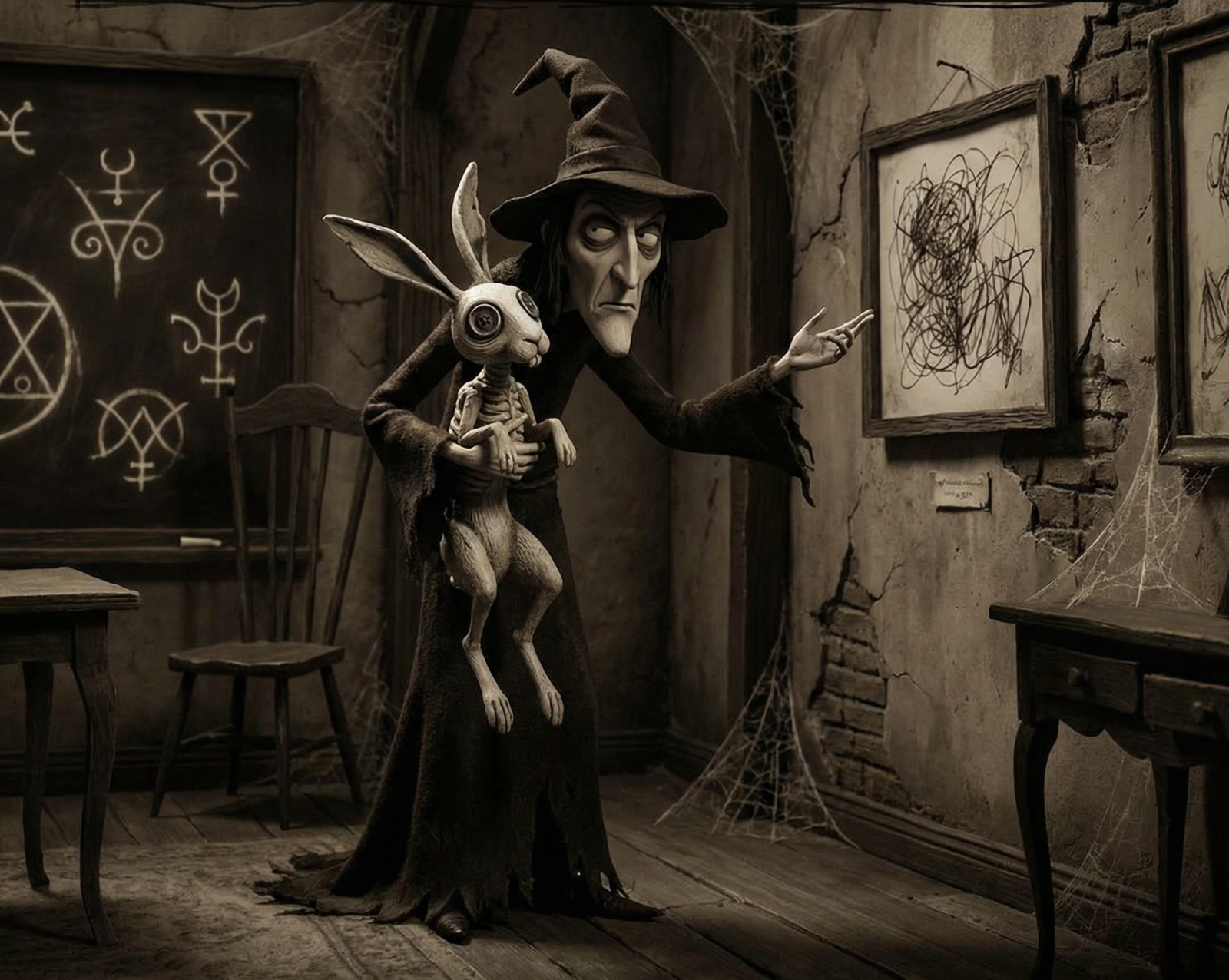
Across the interstitial void, a figure coalesced from a whirlwind of vellum dust and guttering candle smoke. He was tall, hawk-nosed, his eyes burning with the predatory heat of a man who had stared too long into the sun of the Abyss. He wore robes woven from the indigo of a bruised dusk, embroidered with the silver geometries of the Goetia. In his hand, a staff topped with a galena crystal pulsed with a rhythmic, sub-zero light.
Aleister Crowley surveyed the creature with ravenous curiosity. The Hare, his obsidian eyes reflecting a luminescence that never reached the floor, felt no fear—only a deep, resonant knowing. Beuys had taught him to perceive through strata: fat, felt, copper, honey. He mapped this man the same way—layers of performative ego, a razor-thin intellect, a marrow of profound despair, and beneath it all, the white-hot furnace of a Will that refused to break.
“Curious,” Crowley’s voice vibrated, a baritone that shattered the stillness. “A lagomorph, gilded like a Byzantine relic, adrift in the realm of Choronzon. Are you a Tulpa, a familiar, or a particularly droll jest of the Secret Chiefs?”
The Hare could not speak, but he could project. He shifted, the gold leaf on his fur crackling like a dry thought. He didn’t offer a concept—he offered a haunting.
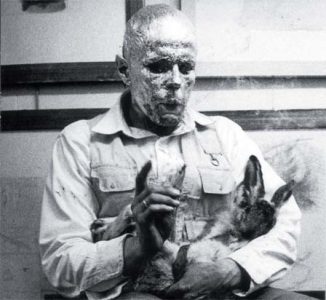
He thrust the sensation of Beuys’s hands into the magus’s mind—the suffocating, insulating heat of the felt room, the claustrophobic seal of honey over the pores, the weight of the artist’s breath. Not art as a gallery object, but art as a working—a blood-ritual to bridge the gap between the living and the silent dead.
Crowley’s eyes widened, a flicker of genuine recognition crossing his sharp features. He tapped his staff, and the crystal flared a violent violet.
“The Artist-Shaman,” Crowley murmured, his tone shifting from mockery to a dark, fraternal appreciation. “He treats matter as a sigil. Fat as memory-store, felt as a psychic Faraday cage. He seeks to explain the world to the dead through the medium of the grotesque. A bit… peasant-tier for my tastes. I prefer my rituals drafted in the blood of stars and the precise mathematics of Thelema.”
He paced the fold, his robes swirling like a brewing storm. “But we are of the same bone-deep sickness, aren’t we? Both of us merely trying to scream loud enough to wake the silence.”
The Hare bowed his heavy, golden head. He broadcast the finality of the gallery—the profound, aching silence of an audience watching a dead animal being told secrets it already knew. It was the communion of the useless and the sacred.
Crowley stopped, looming over the Hare like a shadow. “Your gold leaf,” he whispered, his fingers twitching as if to peel a flake of it away. “It is not decoration. It is a conductor. Aesthetic alchemy. You are the ‘Lead’ of the common beast, transfigured by the ‘Gold’ of the artist’s intent. You are a living—or rather, a dead—talisman.”
A tremor ran through the fold. The edges began to fray into the grey static of linear time. The shared resonance, a bridge built of honey and fire, began to dissolve.
“The currents of the Great Sea shift,” Crowley said, a trace of theatrical regret in his voice. “Our liminal colloquy ends, Brother Hare. You return to your Teutonic silence, to your honeyed lessons. I return to the tempest.” He gave a sharp, mocking bow. “Remember: whether it is the felt of the shepherd or the fire of the magus, the Art is the only weapon that cuts through the void.”
The Hare met the Magus’s fiery gaze one last time. He flooded the occultist’s mind with the taste of ancient honey—thick, cloying, and smelling of the earth—slashing against the cold, starlight-scent of Crowley’s robes.
Then, the fold snapped.
The Hare felt the disorienting jerk of the museum floor. The scent of ritual incense vanished, replaced by the sterile, recycled air of the gallery. The shimmering gold leaf settled into a mere visual echo on his spectral fur.
From somewhere down the hall, the squeak of a janitor’s rubber-soled shoes echoed against the marble, and the faint, rhythmic thrum of the HVAC system reasserted the world of the living.
Back in the aftermath of Beuys’s performance, the Hare carried a new, heavy memory. Not just of the artist, but of a man in the twilight of his own myth who understood that the core of creation is a beautiful, terrifying obsession—a fire that burns the artist as surely as it lights the world. The taste of the honey on his lips felt sharper now, touched by the bitter, distant cold of the Abyss.
dedicated to Joseph Beuys → artist, teacher, performance artist, and art theorist whose work fused humanism, sociology, and an “extended definition of art” he called social sculpture. and. Aleister Crowley → occultist, ceremonial magician, poet, novelist, mountaineer, and painter.

Greatful expression should sometimes be disruptive