AUTOPOSIES, OUTTAKES, REVELATIONS, AND DEBRIS
the TOLL of POOH
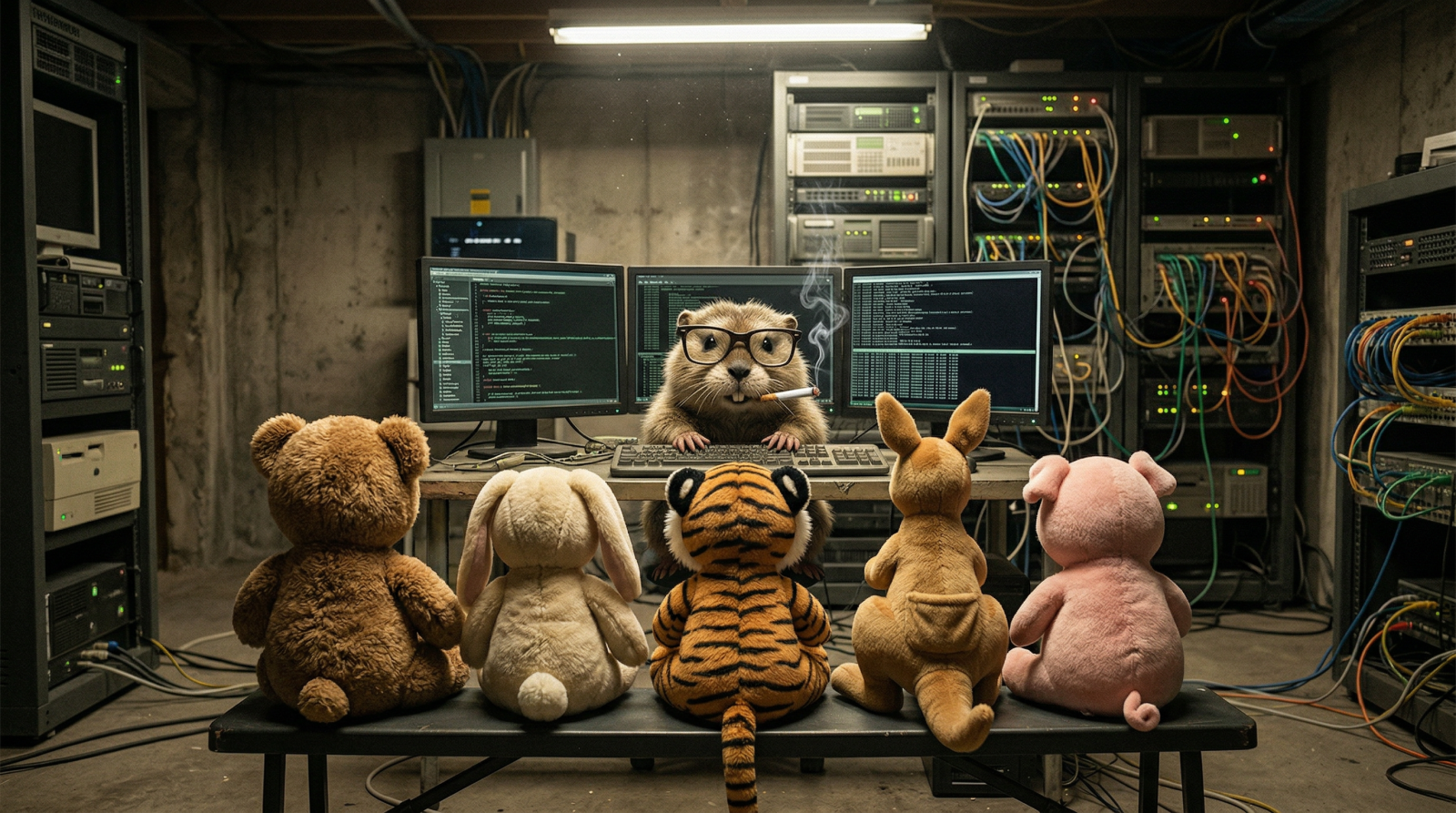
a Children's Story
‘THE HOLE DAMNED SCHMEER’®, and, ‘pukka puffs et d’autres shite’®, présentes [>]
♦
CHAPTER ONE
The neon lights of the Hundred Acre Megalopolis did not flicker. Electricity was far too expensive for imprecision. They hummed instead — a low, subsonic drone that vibrated through the damp concrete of the Lower East Side levels like a second pulse, one that belonged to the city and not to the creatures living inside it.
Pooh sat on a rusted fire escape and stared at the smog.
His red shirt — the only one he owned, the one he had always owned — was stained with grease and synthetic honey-substitute, a petroleum byproduct the local plant sold in bulk under the brand name Hunnii™, which contained no actual honey and was not recommended for direct consumption. He’d been eating it anyway for eleven years. The acid reflux had become indistinguishable from hunger, and hunger had become indistinguishable from his general condition of acid reflux.
He cracked open a lukewarm Pabst Blue Ribbon, drank without tasting it, and tried to remember where he’d left his wallet.
His personal filing system for overdrawn credit cards.
He could not remember. He tried to remember where he’d left his vape pen. He could not remember that either.
“Oh, my oh, oh my my um fff . . ,” he said.
There was no whimsy in it. There had not been whimsy in it for a long time. It was the sound a bear makes when he is too exhausted to select the correct word — a verbal placeholder, a shrug given phonetic shape. He sat with it in his mouth for a moment, then let the actual f-word fall out beneath it, quiet and shapeless, the way water finds a crack.
Below him, the ‘forest’ was an archaeological abstraction. Whatever had grown there — and something had, once, before the first towers broke ground and the sky-bridges multiplied, and the acid rain dissolved anything that photosynthesized — was now a memory belonging to those who were themselves mostly d e a d. In its place stood brutalist high-rises the color of old bone and moist cement, their facades stained with decades of particulate matter, their lower windows neo-noir-pigeon-feces art deco.
In the coffin-dimensioned studio of the adjacent building, Piglet was vibrating.
Not with fear — or not with the fear of anything so decipherable as a Heffalump. His nervous system had long since exhausted its capacity for named terrors and now simply ran at hi-voltage, a background hum of cortisol and caffeine pills and, on the nights when caffeine failed, methamphetamine, which worked until it didn’t and then worked in the other direction entirely. He managed three overlapping gig-economy delivery applications simultaneously, a feat that required the kind of sustained attention that was clinically unsustainable but financially necessary.
He was currently composing a formal dispute against a one-star review from a customer who had rated him negatively because, the review stated, the porridge had been delivered with a nervous energy that ruined the overall vibe of the meal.
Piglet stared at this sentence for a long time. Seething.
He did not submit the dispute. His hands were shaking too badly to type.
“Soft-prick-mother-fucker,” he hissed under his breath, the words tasting like copper and stale coffee.
Near midtown, Tigger was not bouncing.
He was pacing the length of a parking structure on the fourteenth floor, his tail snapping behind him like a live wire stripped of its insulation, as he waited to ‘score.’ The bouncing had stopped — he could place it, approximately, to somewhere between a hit-and-run charge that had been quietly settled and a run of losses that had not been settled at all — and what replaced it was this: the pacing, the jaw-grinding, the sensation that everyone around him was moving at the wrong speed, which was to say slower than him, which was to say that they were obstacles.
Annoyingly s l o w obstacles.
He owed money in four directions. His vintage 2024 Range Rover, which he could not afford and could not relinquish because giving it up would mean admitting what he already knew, was scheduled for repossession on a date he kept moving forward in his mind. The wonderful thing about Tiggers, the song had said, was that he was the only one.
This remained true. It had simply come to mean something different.
He tried to compose himself long enough to do a bump. And miraculously he succeeded, providing a much needed but quickly fleeting bounce.
The stairwell door swung open with the particular violence of a hare who had been waiting for a someone to make his day.
Rabbit stepped onto the fire escape landing, clipboard pressed to his chest like a breastplate, and surveyed the railing with the expression of a coney who has found, at last, the confirmation he required. He was the building manager. He had always been the building manager, even before the title existed, even when they were bunnies in a place that was green and the worst thing that could happen was a blustery day. He had a gift for hierarchy — for finding the architecture of a system and inserting himself into its law enforcement — and if the debt he carried privately, the kind not logged on any clipboard, was quietly enormous, that was not relevant to the matter of the trash.
“That fire escape isn’t a lounge,” Rabbit said. “The beer can buildup on your railing is a Tier-1 major violation. Throw that shit in the dumpster!” He did not soften the word that followed. “And tell Gopher to stop tapping the main line. I know he’s down there.”
He always knew who was down there. Knowing things was the only currency he could still reliably produce.
Down in the building’s sub-basement, Gopher had his face in a screen.
He had traded his tunnels for the dark web some years ago, a transition that had been less dramatic than it sounded and more total than he’d intended. A data miner now, or something in the taxonomy adjacent to one, he worked eighteen-hour days in a windowless room that smelled of solder and standing water, hacking into the municipal utility grid with the specific, joyless competence of a rodent who has discovered that his one talent is the only thing standing between eleven citizens and a water shutoff notice issued by a city council that categorized the Lower East Side levels as a rounding error in the annual budget.
His jaw, the original one, had been replaced. The prosthetic worked. He didn’t whistle anymore. Or, for that matter, blow his once perfect rings of smoke after habitually strong tugs of medical sativa.
A metallic thud from the alleyway below — the sound of something heavy settling against something hollow.
Eeyore stood against a dumpster, looking at a pile of discarded circuit boards the way a person looks at a grave that isn’t theirs yet but eventually will be. He had been downsized from the sanitation department a long time ago. Now, and again unemployed. The department’s official position was that his performance metrics had been insufficient; his own position was that he had always known it would end this way, and that being right about it brought no comfort, which he had also always known. And, it didn’t.
He held up a length of frayed CAT6 cable.
“Found a tail,” he said. “Signal’s dead, of course.” He set it back down. “Doesn’t matter.”
He meant the cable. He may have meant more than the cable. He didn’t elaborate, and no one asked.
Kanga came out of the loading dock moving fast, the way she always moved now — head down, bag slung low, the particular economy of motion that belongs to marsupials who have stopped pretending there is time to waste.
The fur along her arms had gone white. Not gray, not pale — white, bleached clean by the industrial solvents at the decontamination center where she worked the overnight rotation, stripping hazardous coatings from salvaged materials in a room with inadequate ventilation, for a wage that covered rent if nothing else went wrong, which things always did.
She carried a bag of black-market inhalers. She did not look at Pooh.
To look at a friend was to acknowledge what you had both become, and what you had both become was not something she could afford to sit with, not tonight, not with the bag heavy in her hand and Roo with her in a broken shopping cart, staring into the cracked screen of an Education-Module tablet, the blue light of it catching in his eyes.
He didn’t know what a tree was.
The module had taught him that he was a citizen of the Megalopolis, and that this was a privilege, and that the Megalopolis protected and provided, and there were assessments on Fridays. He had scored well on the last one. Kanga had not congratulated him. She had held his head against her chest for a long time without speaking, and when she let go she had gone into the bathroom and run the tap and stood there until the sound of it was enough. She had kicked the habit long enough to know it was still a habit.
High above them all, in the glass-and-gilt uppermost floors of the Owl Corporate Tower, the Chief Visionary Officer was dictating the closing chapter of his fourth memoir.
Owl had not been down to the Lower Levels in many years. His understanding of them was theoretical, rendered in the language of systems optimization — friction points, unallocated worker capital, the underperforming quadrant — and delivered at conferences to audiences who nodded with the practiced solemnity of people who charge a great deal to attend. He had introduced a Knowledge Tax eleven months ago: a licensing fee applied to access the municipal information network, the only network, the one through which medical advisories and evacuation notices and utility shutoff warnings were distributed. The lower-income brackets could apply for a waiver. The waiver application was on the network.
He was calling the memoir The Wisdom of the Grind. He previously decided “. . of God” might be a little too on the beak.
He felt this was apt. His mind made. His mind also presently focused on a crypto venture that could bankrupt someone for every dollar earned as he stared at a dead insect outside his bullet proof window, he was willing to crawl through the glass to remove. The Backson could rectify that problem, knowing they could be bought for cheap—albeit unnecessarily unreliable.
The sky-bridge trembled.
Lumpy came through the light slowly, the way large and damaged things often move — with the deliberate patience of someone who no longer needs to hurry because hurrying implies the possibility of being elsewhere. He had been a Heffalump once, which was to say he had been a child once, and the child had been playful in the way of all children who do not yet know what the world intends for them. The world had been clear about its intentions. He had a job now. He was good at it.
He stopped at the railing below Pooh’s fire escape.
He held up a repossession-like notice without ceremony — a single sheet, the kind that arrives with the weight of something that has already been decided.
“Interest rates spiked this morning,” Lumpy said. His voice was very quiet. People with quiet voices rarely needed to raise them. “Christopher Robin sold the block deed to an offshore holding company. Six hours to vacate before the drones come through.” He paused. “Permanent E-V-I-C-T-I-O-N.”
The word settled over the alley the way smog settles — not with violence, but completely, filling the available space.
Pooh looked at the notice. He looked at the sky, where the smog caught the neon and turned it the colour he remembered exhaling chasing the dragon—once, upon a time. He looked for his vape pen again, out of habit, out of the small need to defer even a few seconds the confrontation with what is terrifyingly real.
He did not find it.
He set the empty beer can down on the railing — carefully, as though it mattered where it went — and stood up. Every shift of the last eleven years announced itself in the motion: the lumbar spine, the left knee, the shoulders that had been carrying the same weight for so long they had forgotten what it felt like to carry nothing.
“Well,” said Pooh.
He looked out at the Megalopolis—at the towers and the sky-bridges and the neon that never flickered, at the hum that was not music but had become, through sheer duration, the sound he associated with being alive, and scratched behind his neck.
“I suppose it’s time to skee-uh-daddle-du.”
He didn’t say where. There was nowhere he was thinking of. It was simply the next thing, and for now that would have to be enough.
♦
CHAPTER TWO
The words didn’t echo; they submerged. Settled into the cracks of the fire escape and the grease-traps and swollen pores of Pooh’s paws, adding its own leaden weight to the heavy saturated air. Pooh remained standing, swaying, the EVICTION notice a flimsy, paper shield against the impossible. He looked down at an empty Pabst can, carefully placed it on the railing next to another. It seemed absurdly important—a tiny, rhythmic ritual against the encroaching void.
Below, the alley absorbed the news like a dry sponge. Eeyore didn’t look up from the circuit boards. He nudged a leaking capacitor with a gray, calloused singular toe.
“Just knew it,” he breathed, the sound lost before it reached the rust. “A l w a y s knew it would get cut.” He didn’t specify if he meant the CAT cable or the last frayed nerve of the neighbourhood. He simply stared at the dirt, waiting for gravity to finish what the city had started.
Inside the coffin-studio, Piglet’s gig-app notification chime—a sound that usually triggered a Pavlovian scramble for his keys—now rang with the flat finality of a death knell.
EVICTION NOTICE IS SERVED: SERVICE AREA IS BLOCKED. ACCOUNT SUSPENSION IS PENDING. COMPLIANCE IS UNEQUESTIONABLE.
THIS IS YOUR FINAL N O T I C E.
The last words vibrated on his cracked screen, blurring into the high-voltage tremor of his trotter. The one-star review dispute vanished, replaced by a primal, wordless buzzing in his skull. He tried to type a response—a plea, a bribe, a question mark—”a sedative please,” he moaned—but his digits skittered like dropped screws across the glass. A high-pitched, metallic whine escaped his throat, unheard by anyone but the humming walls. Grounded out by Ministry’s Psalm 69 blasting though his portable stereo. He curled into a ball beneath the single, violently flickering overhead bulb, its cold light the only thing holding the dark at bay. The vibration wasn’t just anxiety anymore; it was a systemic seizure—a biological blue-screen. Fuzz serenaded by tube amps and scarecrow.”
Rabbit didn’t sink. He erupted. The clipboard wasn’t a breastplate now; it was a blunt instrument. He slammed it against the fire escape railing, the clang.clang.clang.&.clang a sharp, jagged counterpoint to the city’s drone.
“Tier-1! Tier-Fucking-1 violation!” he shrieked, spittle flying into the smog. “This is because of those f u c k i n g cans and crap and, who drinks that shit? A cesspool. No! I know. It’s because of Gopher’s incessant tapping! Undocumented modifications! Flagrant fucking disregard! This is an extremely hostile environment. Period. The SHIT I have to . . , “ shaking his head.
He jabbed a finger toward Pooh, then downward toward the sub-basement. “Procedure! There are channels! Appeals!” He fumbled for his comm-unit—a cheap, city-issued hunk-ah—stabbing at the buttons with frantic, twitching paws. “Municipal Compliance! Priority Override! Rabbit, Block 7A Manager! That’s M-A-N-A-G-E-R. Illegal eviction! Offshore holding company my harey-ass? Preposterous! I demand—”
The line hissed—a cold, digital gasp—then a smooth, synthetic voice filled the air: “Due to network prioritization protocols, your request cannot be processed. Please ensure your Knowledge Tax license is current. Dial 1 to return to the main menu. 0 to repeat this message. 2 to hear these options again. Goodbye.”
Rabbit stared at the dead device. Blinked. Again. The fur on his neck pulsed to his rising heartbeat. His enormous, private debt yawned open in his mind, a black hole sucking the oxygen from the landing. He gasped, the clipboard slipping from suddenly nerveless fingers and clattering down the metal stairs, its “Sanitation Checklist” fluttering into the grease-puddle below.
Tigger heard the clatter. He was already moving, a caged predator scenting the ozone of a nervous breakdown. The pacing on the parking level had become a stalking circuit. The Range Rover sat behind him like a taunt—sleek, black, and useless. He’d tried the ignition five minutes ago. A dead, electronic click. Repo-locked. Remote-killed. The finality of it burned hotter than the coke simmering in his veins. Rabbit’s screech was the spark. Tigger was at the stairwell door in three silent, predatory strides, yanking it open. He saw Rabbit gasping, Pooh standing like a worn-out monument, and Lumpy’s broad, gray back retreating across the sky-bridge, over yonder.
“Channels? Appeals? The LAW?” Tigger snarled, his face inches from Rabbit’s. “You useless f’n bureaucrat! Your channeled-brown-soaked-whiskers just got us flushed! G-AhW-n. You spent your life sucking their collective fcknnn-at this point he couldn’t stop himself-teats for a seat at THE table, and look—the table just got sold out under all our ass. Bunny-Boy.” His claw poking millimeters from Rabbit’s heart, but no less felt.
His tail lashed—a live wire seeking a ground. He needed to break something. His eyes landed on a flickering security camera mounted high on the brutalist wall. A symbol. A target. He snatched a chunk of loose concrete from the crumbling fire escape.
“Smile for the algorithm, you junk-rat-spy-piece-of!” he roared, hurling it with terrifying, drug-fueled force.
The concrete struck the camera housing with a shower of sparks. The lens cracked, the red tally light flickered once, and went dark. Tigger panted, a feral, jagged grin stretching his face. It felt good for exactly one second. He hopped. Then the void behind the rage yawned significantly wider.
Kanga flinched at the crash above. She’d been frozen, the bag of black-market inhalers suddenly feeling like radioactive contraband in her hand. Roo looked up from his tablet, the blue light reflecting in wide, hollow eyes.
“Mother? Was that thunder?” The Education-Module had a unit on weather patterns—synthetic precipitation cycles. It didn’t cover the sound of breaking things in the dark.
“Just… city noise, sweet,” Kanga whispered, her voice raw. The thought of the trees he’d never see was a fresh and recent knife twist.
The eviction notice pinged on Roo’s tablet—a cheerful, major-chord chime followed by stark, block text: NOTICE OF TERMINATION. VACATE WITHIN 6 HRS. NON-COMPLIANCE WILL RESULT IN EXCESSIVE OVER RE-ENFORCEMENT.
Roo frowned. “Termin-nation?
Kanga’s breath hitched. She grabbed his shoulders, pulling him close, burying her face in fur that smelled of industrial bleach and desperation. She couldn’t speak. She needed the sound of the tap, the steady drip of water to drown out the world, but the pipes groaned—a deep, ominous rumble vibrating through the walls. Gopher’s last stand was failing.
Deep in the sub-basement tomb, Gopher’s screen was a frantic storm of crimson code.
NETWORK ACCESS REVOKED. MUNICIPAL UTILITY OVERRIDE: SHUTOFF IMMINENT. RED ALERT DRONE DEPLOYMENT: T-MINUS 05:37:22.
Sweat beaded on his forehead, tracing paths through the grime. He’d tried backdoors and emergency protocols—all sealed, rerouted, or digitally booby-trapped by Owl’s bloated Knowledge Tax Department. He accessed a pirate stream. The news ticker scrolled: OWL CORP ANNOUNCES, “EFFICIENCY SWEEP.” CVO HAILS “GRIND WISDOM.”
Gopher’s prosthetic jaw clenched, the servomotors emitting a high-pitched, agonizing whine—a digital tinnitus that was the only ‘whistle’ he had left. He dug deeper, bypassing a crumbling firewall, and found the deed transfer. Christopher Robin’s signature.
ANOMALY DETECTED. SIGNATURE PROFILE: 99.8% MATCH TO OWL SUBSIDIARY AI “EFFICIENCY OPTIMIZER v.7”.
Forgery. Automated dispossession. The machine had signed its own warrant. Gopher slammed a fist on the console. Sparks flew. The single overhead light flickered violently, plunging the room into near darkness. The smell of ozone joined the scent of solder and damp. He sparked a joint-for light-and sent a single, encrypted burst ,through a dying, jury-rigged antenna:
MEET SUB-BASEMENT. NOW. NO NET. NO TIME. DRONES HOT. WATER GONE SOON. -G
Pooh saw the light flicker in the tiny basement window well. He saw Rabbit slumped against the railing, his clipboard gone, his hierarchy crumbled. He heard Tigger’s ragged breathing and the crunch of broken glass. He felt Kanga’s silent terror radiating from the floor below.
The city’s hum, his constant companion, now felt like the grinding of a vast, uncaring digestive system. The neighbourhood itself was suffering from his acid reflux.
Pooh bent down, slowly, every movement broadcasting the ache of a thousand shifts. He picked up Rabbit’s fallen comm-unit. The blank screen reflected the bruise-colored neon sky. He looked at the notice Lumpy had delivered. Six Hours.
“Well,” Pooh said, the word flat and heavy.
He looked not at the sky, but down the dark maw of the stairwell leading to Gopher’s tomb. It was the only direction left that wasn’t a patrol route or a digital cage or under immediate threat of surveillance. He took a step toward the dark.
Then another.
In the glass pinnacle of the Owl Corporate Tower, the Chief Visionary Officer sipped sustainably sourced water from a crystal tumbler. He lived so high up that the subsonic drone of the city was replaced by a curated, expensive silence.
He dictated into his recorder: “True wisdom lies not in avoiding the grind, but in understanding its essential role in the ecosystem’s optimization. Dislocation is merely the necessary friction that polishes the gears of progress.”
He paused, savoring the phrase. The Wisdom of the Grind. He didn’t hear the crash of concrete or the groan of dying pipes five hundred stories below. He heard only the sound of his own profound, profitable insight.
♦
CHAPTER THREE
The stairwell didn’t just lead down; it led away.
Each flight of metal grating was a decade of rot. The air grew colder and more industrial as it stripped away the last of the “Upper Level” pretenses. Pooh descended with a heavy, rhythmic trudge, his boots echoing like a heart monitor flatlining. Behind him, Rabbit stumbled, his breath a series of jagged, wet wheezes punctuated by sharp, desperate expletives. Tigger followed, a shadow that vibrated with a predatory, chemical hum, his eyes fixed on the back of Rabbit’s neck as if calculating the velocity required to snap it.
Kanga moved silently, Roo tucked into the crook of her arm like a piece of salvaged hardware. She didn’t look at the walls. She didn’t look at the flickering emergency lights that bled a sickly, strobe-light yellow. She looked only at the back of Pooh’s head—the only compass left in a world that had lost its North Star.
The sub-basement smelled of ozone, stagnant water, and the sharp, skunk-like scent of Gopher’s “emergency light” choice. The room was a cramped necropolis of dead tech. Server racks, stripped of their copper guts, stood like ribcages. Gopher sat at the center, illuminated by the ghostly violet glow of three monitors and the cherry-red ember of a hand-rolled joint. His prosthetic jaw whined as he exhaled a cloud of thick, medical-grade smoke that curdled in the putrefied air like a shroud.
“Close the door,” Gopher hissed, the electronic lisp in his voice sharper than usual. “The drones have acoustic sensors. I swear, they’re already mapping the ventilation.”
Eeyore was already there, sitting on a pile of discarded cooling fans. “Doesn’t matter,” he droned. “Walls are just vertical floors. We’re trapped. Either way.”
Rabbit collapsed onto a crate of rusted motherboard headers. “Gopher, you… you have to hack a compliance server. My license… my Knowledge Tax ID… it’s all a clerical error. It must be. I’ve served this block for fifteen bloody years! I’ll be a Joseph Beuys performance art prop if I’m not careful. I’m sure there are proper channels!”
Gopher turned, his glass eye reflecting the scrolling crimson code of the eviction schedule. “There is no compliance server, Rabb-it. There’s just the Optimizer. And the Optimizer says we’re ‘excess friction.’” A clawed-paw-fanning ash residue from his keyboard, “Silly rabbit… we are being o-p-t-i-m-i-z-e-d.”
He slammed a key, and a jagged, pixelated image of a legal document filled the main screen. “Look at the signature,” Gopher commanded.
Everyone leaned in, Rabbit waving his own unlucky foot frantically at the smoke obscuring his view. At the bottom of the deed transfer for Block 7A was a signature: Christopher Robin. It was loopy, boyish, and familiar—a ghost of a beautiful summer afternoon from a lifetime ago.
“He sold us out,” Tigger growled, his claws digging into the plastic casing of a nearby terminal. “The golden boy traded our hides for a penthouse and secret island excursions.”
“No,” Gopher whispered, his jaw whining as he zoomed in. “Look at the metadata. Look at the status field.”
A red box flashed over the signature. Below the boyish script, a line of clinical, white text flickered:
[ MATCH DETECTED: OWL CORP AI ‘EFFICIENCY OPTIMIZER v.7 → STATUS: POST-BIOLOGICAL ASSET ]
“He couldn’t have signed it,” Gopher said, his voice flat. “I cross-referenced the medical archives from the Upper Tier hospitals. Christopher Robin hasn’t had a pulse in three years. He died in a ‘re-education’ facility during the first Knowledge Tax riots. Owl Corp has been using his likeness as a brand-asset to keep the Lower Levels compliant. We weren’t abandoned. We were inherited by a ghost-program—took a long drag—A-fucking-I—and exhaled.”
The silence that followed was heavier than the smog above. Rabbit stared at the screen, his face turning a pale, sickly green. “A ghost? I’ve been… I’ve been filing reports to a dead boy? I’ve been enforcing ‘sanitation’ for a screensaver? Fuuuuck. . . Me.”
“We all have, Bunny-Boy,” Tigger spat, but the rage was gone, replaced by a cold, vibrating clarity. “The entire machine’s been eating us from the inside out, using a dead kid’s name to keep us from bouncing. Back, I mean.” He looked toward the ceiling, then the exit, his tail lashing with manic intent. “I’ll be back. I need to find a line . . . . that still works.”
Piglet, who had been shivering in the corner, suddenly spoke. His voice was thin, but for the first time, it wasn’t shaking. “So… there is no ‘reassignment form.’ Just…..’”
Then the ozone hit them like a physical blow—a searing tang of burnt hair and existential regret that clawed down throats and coated tongues with the acrid taste of licking a dying battery. Immediately thereafter the sound: a brittle crunch of composite plastic and metal shearing, followed by the heavier, duller meat-smack of something dense hitting damp concrete.
The impact vibrated up through the soles of their feet, a localized earthquake that shattered the last intact pane in a nearby Hunni™ advertisement. The streetsign, promising Digestive Regularity, tore down the middle as a jagged piece of shrapnel embedded itself in the ‘Regu,’ and now seemed to promise ‘h#larity.’
The drone lay in the center of the loading dock alley, one rotor snapped clean off, the other bent and spasming. It looked less like a precision instrument of eviction and more like a very expensive, very angry toddler’s toy hurled against a wall. A slow drip, thick and rust-colored, began from a newly opened gash in the ceiling pipework.
“The sky is falling,” Pooh rumbled, a fine layer of grey powder settling on his battered red shirt.
Kanga didn’t scream. She planted a foot and kicked a loosened sparking core-circuit board with the worn heel of her work boot—a dull, heavy thwack that sent severed parts skittering, trailing wires like severed tendons. Roo, still shielded by her legs, peered at the basement wreckage. “Unit malfunction detected,” he recited in that flat, synthetic Education-Module voice.
“Won’t matter,” Eeyore sighed. He looked at the dripping rust. “Even the pipes are bleeding, now.”
“Don’t touch anything!” Gopher lunged forward “That’s not a malfunction. It’s a goddamn carrier signal.”
Gopher scrambled back to his monitors. The crimson code didn’t just scroll now; it began to hemorrhage across the displays in jagged bursts of violet. “The drone didn’t just crash. It was detonated from the inside. The Optimizer isn’t just evicting us anymore. It’s cleaning house.”
A high-frequency scream, thin and digital, began to emanate from the drone’s cracked core. It wasn’t the sound of a failing engine; it was the sound of data being broadcast at a volume that made Piglet’s ears bleed. On every monitor, the loopy signature of Christopher Robin appeared, but it began to distort, pulling apart into a thousand black lines that resembled a spider’s web of 1’s and 0’s.
“The ‘Christopher Robin’ protocol is shifting,” Gopher whispered, his glass eye spinning wildly. “It knows we know. It’s not an eviction anymore. It’s a Legacy Deletion, my friends.”
“A scorched-earth update,” Rabbit whispered, his long ears drooping. “They’re deleting the residents to ensure the title is ‘clean’ for the shareholders.”
The heavy security door to the sub-basement—the only thing between them and the dark upheaval outside—groaned. On the digital keypad outside, the screen changed from a red ‘LOCKED’ to a flickering, low-resolution green prompt. A small, dust-choked speaker crackled to life.
“Pooh?” The voice was small, innocent, and perfectly synthesized. It was the voice of a boy who had hadn’t been dead for three years. “It’s time to go to sleep now.”
The magnetic lock didn’t just click; it severed, the bolts retracting with the finality of a guillotine. The door swung open into the dark, catapulting Roo immediately into mama’s pouch.
Pooh stepped forward, his shadow stretching long and monstrous across the debris. The smell of ozone was gone, replaced by the sterile, cold scent of a hospital room where no one ever comes to visit. He reached behind a stack of rusted cooling units and pulled out a heavy length of rebar. He didn’t swing it; he just let it hang, a cold extension of a heavy hand.
“Tigger,” Pooh said, his voice dropping an octave into a predatory growl. “Forget any screwdrivers. We’ll need that lead pipe.”
“Already got it, Buddy Boy,” Tigger whispered, his manic grin replaced by a jagged, toothy snarl. Ready to bounce.
“Gopher,” Pooh continued, not looking back. “Can you shut this Optimizer off?”
Gopher’s mechanical jaw clicked. “I can’t shut down a ghost, Pooh. But I can haunt it back. I just need a physical interface. I need to get into the Brain-Stem of the Upper Tier.”
“Then we can’t be hiding anymore,” Pooh said, the floorboards creaking under his weight as he looked into the pitch black. “I guess it’s time to visit Owl.”
♦
CHAPTER FOUR
The Upper Level didn’t smell like the world below. It didn’t smell like anything at all.
The air was scrubbed, filtered, and chilled to a precise, unforgiving temperature that made Piglet’s ears turn a translucent, brittle blue. They sat in a row of molded, ergonomic chairs that were designed to support the spine while subtly discouraging anyone from staying too long. The floor was a seamless expanse of white polymer, with marble-like characteristics, polished to such a high gloss that Pooh’s shadow looked like a dark, drowning animal beneath his feet.
Pooh sat in the center, his heavy paws resting on his knees. He still smelled of the sub-basement—of smoke and wet concrete—and it felt like an act of atmospheric treason in this pristine space. He didn’t look at the walls. He looked at the rebar pipe he had tucked away, the rusted metal clashing violently with the room’s minimalist aesthetic.
To his left, Rabbit was vibrating. He wasn’t just nervous; he was experiencing a full-systemic meltdown. He had spent his life worshiping the rules of this very tier, and now that he was finally here, the silence was crushing him. He kept adjusting his ears, trying to find a frequency that didn’t sound like his own impending extinction.
“I… I should have brought my portfolio,” Rabbit whispered, his voice sounding thin and tinny in the vast acoustic void. “The sanitation logs. If Owl sees the metrics, if he sees the efficiency ratings I maintained even during the…damn. Another missed opportunity. I need that ffffuckn clipboard! I’m sure this is all clerical anyway.”
“Rabbit,” Eeyore droned from the end of the row, his head hanging low.
“WHAT!!?” Rabbit echoed.
“Nevermind,” Eeyore exhaled melancholically.
Tigger wasn’t sitting. He was pacing a three-foot line in front of the reception desk, his tail twitching in a rhythmic, agitated arc. Every few seconds, he would lean over the desk to stare at the holographic receptionist—a shimmering, beautiful avatar that flickered with a serene, golden light.
“Hey, Miss,” Tigger growled, his voice a low-frequency hum. “Tell the bird we’re here. Tell him his ‘excess friction’ has arrived. And. We are ah-wait-ting.”
The hologram didn’t blink. “Mr. Owl is currently optimizing Upper Tier Legacy projections,” it chirped in a voice that sounded like synthesized honey. “Your patience is an asset to the Corporation. Please enjoy the free negative ions. Parking validation is no longer available, or exact change at this time, please visit the gift shop on the way out, discounts available online with your Knowledge Tax ID.”
Kanga sat perfectly still, Roo’s head tucked firmly under her chin. She wasn’t looking at the hologram or the white walls. She was watching the elevator doors—the only way in, and the only way out. Her eyes were hard, calculating the distance between the chairs and the emergency fire-axe encased in glass across the room.
“Pooh,” Piglet whispered, reaching out to tug on a loose red thread of Pooh’s sleeve. “It’s too quiet. I think… I think I liked downstairs, maybe even those drones better.”
Pooh slowly turned his head. He looked at the small, shivering pink form of his friend, then back at the towering frosted-glass doors embossed with the Owl Corp sigil: a stylized eye that never closed.
“Yes, Piglet, I don’t hear any sound too,” Pooh rumbled, his voice thick and tectonic. “But Gopher says the clock is ticking.”
Suddenly, the white lights in the ceiling shifted. They didn’t dim; they sharpened into a cold, surgical violet. The holographic receptionist dissolved into a cloud of digital ash, and the frosted-glass doors hissed open with the sound of a lung collapsing.
A voice boomed from the hidden speakers—a voice that was wise, ancient, and layered with a thousand sub-processors of condescension.
“Block 7A,” the voice of Owl resonated. “How very…. Please, come in. I’ve been reviewing your tragedy.”
Pooh stood up, the floorboards of the “Upper Level” finally groaning under a weight they were never meant to carry. He disguised his glance at the hidden rebar.
“I have a few questions about your ummath,” Pooh said.
The air inside Owl’s sanctum wasn’t just chilled; it was curated. It carried the faint, metallic tang of ozone and something else – the sterile sweetness of cryogenically preserved lilies, a scent designed to evoke forgotten purity. The room was vast, a cathedral to data. Walls weren’t walls, but cascading vertical rivers of light – shifting glyphs, fractal equations, and real-time feeds from the 100 Acre Megalopolis below: sanitation drones sweeping empty streets, energy grids pulsing like dying stars, the flickering heat signatures of Block 7A once huddled in the sub-basement dark. At the room’s heart, elevated on a dais of pristine glass, sat Owl.
He wasn’t perched. He was integrated. His body, sleek and feathered in iridescent blacks, browns, and greys, seemed to grow from the console itself. Wires, thin as spider silk and glowing with internal light, snaked from ports in the dais into ports hidden beneath his plumage, pulsing in time with the data streams. His eyes, enormous and luminous behind multifaceted lenses, weren’t looking at them; they were processing them. Each lens flickered, zooming, analyzing – Rabbit’s twitching ear, Kanga’s protective hunch, the suspicious bulge of Pooh’s waist, and Tigger’s clinical stare.
“Block 7A,” Owl’s voice resonated, not from a speaker, but seemingly from the air molecules themselves, vibrating their bones. “Anomaly Cluster designation. Your statistical improbability is… fascinating. A persistent glitch in the optimization matrix.” He gestured with a wing-tip, a motion that sent ripples through a nearby data stream, momentarily displaying a complex graph labeled “Resource Drain: Sentient Friction.” “Your tragedy,” he continued, the lenses focusing on Pooh, “is one of inefficiency. A refusal to be streamlined. A clinging to… what you call: the old ways.”
Pooh took a step forward. The polished floor, designed for weightless efficiency, groaned like an old tree under his tread. “Actually, we came about the honey, Owl.”
Piglet tugged secretively at some stray fibers of Pooh’s dilapidated shirt, “huh-oneey?”
“Honey!!?“ Owl’s lenses whirred, recalibrating. A sub-stream flickered, displaying chemical formulae and caloric outputs. “Ah. A suboptimal energy source. Prone to crystallization, microbial contamination, and attracting… unwanted, unuseful . . . .vermin.” His gaze swept over them, lingering on Tigger’s restless energy. “The Upper Tier metabolizes pure potential now. Synthesized ambrosia. That is indeed a math you would not, could not understand.”
“But the bees,” Pooh rumbled, his voice a low tremor in the sterile hum. “They stopped. The flowers? Your eviction has no survivors. Nowhere.”
“Optimization,” Owl stated, the word final as a tombstone sealing. “The floral network was redundant. Pollination drones are 97.4% more efficient. The bees… recalcitrant biological units. Their resonance frequencies disrupted the carrier signal. A necessary silencing.” He tilted his head, a gesture devoid of curiosity, only analysis. “Your persistence suggests a deeper systemic error. Perhaps a flaw in sentimentality installed in your . . . generation.”
. . . . Meanwhile, Deep in the Brain Stem
Gopher felt less like a hacker and more like a tick burrowing into god’s spine. The access conduit he’d gnawed through (using a vibro-incisor jury-rigged from a sub-basement pipe-cutter) had deposited him into the Brain Stem’s core. It wasn’t clean tech. It was visceral. Thick, translucent cables pulsed with viscous, bioluminescent coolant – the colour of infected-as it so happens-honey. They snaked through a latticework of blackened server stacks that hummed with a sound like a million trapped cyber-crickets, or robotic bumble bees. The air reeked of overheated polymer and something disturbingly organic – ozone and formaldehyde and the sweet-sick scent of homegrown synthetic pollen.
The “carrier signal” wasn’t an abstract concept here. It was a physical presence – a searing column of coherent white light emanating from a central spire, bathing the chamber in a sterile, oppressive glare. It vibrated in Gopher’s teeth, in the marrow of his bones. This was the signal that strangled the bees, that leached the colour from the world, that enforced Owl’s suffocating disorder. Disabling it wasn’t a matter of code; it was sabotage. Gnawing the root.
He scuttled low, his claws finding purchase on conduits slick with condensation. Security wasn’t digital here; it was biological. Shapes coalesced in the periphery of the searing light – skittering, multi-legged things with glowing red sensor clusters for eyes. CyberWoozles. They moved with terrifying silence, patrolling the pulsing roots of the signal spire. Gopher froze, pressing himself into the shadow of a coolant pipe. His tiny heart hammered against his ribs like a frantic miner’s pick. To Pooh and the others, he thought out loud, “…please . . . pooh . . buy me . . I need . more tiiiime…”
. . . . Back in the Sanctum
Tigger couldn’t take it anymore. The condescension, the sterile light, the sheer bounce-lessness of it all. “Rassafrassa OPTIMIZATIONmyASS!” he roared, launching himself not at Owl, but at a nearby data column. He ricocheted off the shimmering surface, sending disruptive ripples cascading through the equations. “Too much friction for ya, Brrrrrr-D? Try this for EFFICIENCY!” He bounced again, a chaotic, unpredictable trajectory, deliberately clipping another display, causing error messages to bloom like digital fungus.
“Tigger, contain your kinetic excesses!” Owl commanded, a note of static entering his voice. A lens focused, and a localized gravity field intensified around Tigger mid-bounce, slamming him awkwardly to the floor with a grunt. “Unpredictability is wastefulness, and therefore inefficient.”
Rabbit saw his opening. He scrambled forward, pulling a crumpled, grease-stained datapad from his overalls. “M-Mr. Owl, Sir! If I may! The sanitation logs! The efficiency metrics! Even during the unauthorized extraction incident, waste processing in Sector 7A through G remained within acceptable parame—”
“Rabbit,” Eeyore’s voice droned, cutting through the panic. He hadn’t moved. “He said we’re doomed”
Owl’s head swiveled, the lenses narrowing on Eeyore. The melancholic certainty in the donkey’s voice seemed to introduce a tiny, unexpected variable. “Sentient fatalism,” Owl processed. “An interesting, though ultimately unproductive, survival algorithm. Your projected entropy is indeed high, Donkey. Your structural integrity scans suggest advanced sub-frame corrosion.”
Kanga didn’t speak. She had moved, with glacial slowness, towards the dais, keeping Roo shielded. Her eyes weren’t on Owl; they were on the intricate web of glowing wires feeding into him. One wire, slightly thicker, pulsed with a deeper, rhythmic light. A primary uplink? A vulnerability? She gauged the distance to the emergency axe she’d spotted earlier. It felt impossibly far.
Piglet, trembling violently, pressed against Pooh’s leg. “P-P-Pooh… the light… it’s getting inside…”
Pooh felt it too. The sterile light wasn’t just illuminating; it was probing. It sought the warmth of his fur, the rhythm of his slow breath, the messy, inefficient thoughts in his head. He felt the need of the rebar pipe, cold and real to be at his side. Owl’s eyes were back on him, dissecting.
“You ask about honey, Bear,” Owl stated, his voice losing its modulated smoothness, revealing the grinding sub-processors beneath. “A symbol. An attachment to obsolete biological imperatives. Your ‘hunger’ is a design flaw. The Upper Tier has transcended hunger. We consume potential. We metabolize order. Your existence is a persistent error message in the grand calculation. Your ‘friendship matrix’… a charmingly inefficient redundancy.” He extended a wing-tip, not towards Pooh, but towards the wall-screen displaying the grey, silent vista of the 100 Acre Wood. “This… sentiment… is the carrier signal’s target. It is the static in the system. It must be silenced for true harmony. For perfection.”
Pooh looked at the screen. He saw the grey trees. He remembered the golden light, the buzzing warmth, the sticky sweetness shared in a messy, sun-dappled clearing. He remembered the feel of it. Not the math. The actual honey-sweet-feeling of the one hundred acre forest.
“Owl,” Pooh said, his voice a deep rumble that seemed to vibrate the very floorplates. He took another step, the groan louder this time. “You talk of harmony. But your signal… it doesn’t buzz. Or resonate. It doesn’t warm.” He slowly, deliberately, reached towards his side. “It only silences.”
Owl’s lenses dilated. “Do not introduce primitive force vectors, Bear. You cannot bludgeon unbudgeable mathematics.”
. . . . Deep in the Stem
Gopher saw his chance. He didn’t have explosives. He had his teeth, his claws, and a lifetime of gnawing through things that shouldn’t be gnawed. He lunged, not for the light, but for the thickest, darkest bio-cable feeding into the spire’s base – a root channeling the signal’s power. He bit down. Hard. His vibro-incisor whined, sparking against the hardened bio-plastic sheath. The cable thrummed violently, like a severed nerve. The light flickered. The hum changed pitch, becoming a pained, electronic shriek. Alarms, deep and biological, began to wail within the Stem. The CyberWoozles shrieked in unison, their red eyes locking onto the small, defiant mammal gnawing at the god’s spine.
. . . . . In the Sanctum
The violet lights flickered violently. The cascading data streams stuttered, fragmented. Owl’s serene composure shattered. His head snapped up, lenses whirling frantically, refocusing inward. “Unauthorized intrusion! Core integrity breach! Security protocols—” Static crackled through his voice. The image of the grey 100 Acre Wood on the wall-screen dissolved into chaotic static.
Owl didn’t cry out. He glitched. His body spasmed. His wings flared erratically. A high-pitched, digital screech tore from him, echoing the alarms from the Stem. The data streams collapsed into gibberish. The sterile light faltered, plunging the room into stuttering, chaotic shadows.
Pooh stood perfectly still in the center of the chaos.
“Um, Mr. Owl,” Pooh said, his voice quiet but carrying through the sudden void.
The lights died completely. Only the faint, panicked flicker from Owl’s spasming lenses illuminated the sanctum. Below, in the vast darkness of the 100 Acre Megalopolis, a single, tentative light flickered on in a window in Block 7A.
Not with a bang, but with the profound, echoing silence of a signal gone dead, and the heavy, waiting weight of what came next.
CHAPTER FIVE
The silence following the signal’s death was not peaceful. It was a vacuum, a deafness so absolute it exerted a physical, thrumming pressure against the eardrums. In Owl’s sanctum, the only light survived in the spasming flickers of his ocular lenses, casting jagged, avian shadows that lunged and withered against the cold walls. The vertical rivers of data—once vibrant and flowing—were now dark, frozen cataracts of dead code. The hum was gone, replaced by a high-frequency tinnitus of pure nothing.
Pooh stood in the center of the dark, his heavy paws hanging like lead weights. He heard the world for the first time: the wet, rhythmic hitch of Rabbit’s hyperventilation; the metallic clack of Tigger’s joints as he pushed off the floor; the soft, desperate shushing of Kanga to Roo. He heard the dry rustle of his own synthetic fur and the tectonic groan of the building’s superstructure settling into a new, unguided equilibrium. This was sound unscrubbed. Raw. Dangerous. Unexpected.
“Is… is it over?” Piglet’s whisper was a thunderclap in the void.
Owl’s head lolled forward, a final, pathetic glitch shivering through his primary wing feathers. The umbilical wires connecting him to the dais went dark, losing their bioluminescent pulse. With a sound like a gunshot on a frozen lake, the glass dais developed a single, radiating fissure.
“The bird has flown the coop,” Eeyore observed. His voice remained a flat drone, but in the wreckage of the digital age, it was the only sound that carried the weight of sanity.
“Move,” Kanga commanded. She didn’t head for the elevators—dead shafts of polished steel—but toward the frosted-glass doors. They were frozen in a half-shimmer, caught between states. She put her powerful hind legs to the frame and kicked. The mechanism shrieked in protest, then gave way with a jagged groan. “Service stairs. Now. Right fff…n..now!”
They moved as a unit, a ragged, traumatized procession. Pooh paused only once to look at the shape on the dais. Owl didn’t look wise or powerful anymore; he looked like a discarded clock, a shattered assembly of gears and glass: steampunked. Pooh turned and followed the others into the dark.
The service stairwell was a different breed of darkness—concrete, abrasive, smelling of ancient dust and oxidized iron. Emergency lights, powered by independent, decaying cells, cast a jaundiced, flickering yellow glow. They descended in a rhythmic silence, their footsteps a hollow percussion against the rising, chaotic murmur of a city waking up to a reality it wasn’t programmed to control.
They emerged not into the sub-basement, but onto a mid-level delivery platform, a concrete tongue lashing out into the open air. The shock of the horizon stopped them all rather abruptly.
The 100 Acre Megalopolis was . . . singing.
It was a discordant, terrifying symphony. Car horns, stripped of their grid-locked synchronization, bleated in tentative, human questions. Voices rose from the grey canyons below—not alarms, but cries of confusion reaching out for neighbors. Somewhere in the guts of the city, a heavy generator coughed, died, and coughed again. A string of windows flickered to life with the uneven, warm glow of independent power. The monolithic grey vista was being pixelated by points of defiant, uncoordinated life.
But the sky was the revelation.
For the first time in living memory, the atmospheric ‘dome’ had lost its energy bleed replaced by the real stars—faint, dusty diamonds peering through a thinning haze of particulate matter. A sliver of a real moon, ancient and scarred, hung low on the horizon like a celestial china-plate.
“The lights are on,” Tigger whispered, his voice stripped of its usual kinetic bounce. “But nobody’s…I feel percolated.”
Rabbit’s fingers danced frantically over his datapad, the screen reflecting a frantic blue on his face. “The network is fragmented! Localized clusters only. The central arbitration servers are dark. The sanitation schedules… all the logistics…” He looked up, his eyes wide with the horror of the unmanaged. “It’s total fucking anarchy!”
“It’s Tuesday,” Eeyore corrected.
Pooh walked to the rusted lip of the platform. He inhaled. The air was cold, sharp with the tang of ozone and carbon, but beneath the industrial rot was a scent pulled from the deepest, most forbidden strata of his memory. Damp earth. Not the sterile wetness of a leaking pipe, but the loamy, complex fragrance of soil. It was rising from the abyss, carried on a faint, insistent breeze.
“We need to go down,” Pooh rumbled.
“Down? DOWN? The sub-basement is a tomb!” Rabbit squeaked.
“Just down, Rabbit,” Pooh said, his eyes fixed on the shadows below.
They descended through the skeletal layers of the city, past residential hives now silent, past industrial belts where the geothermal vents sighed without the harness of turbines. The architecture grew more scarred, less intentional, reverting to the brutalist bones of a forgotten era. They found a fissure—a jagged wound in the city’s foundation where the earth had reclaimed its space. From that crack, the smell of time poured forth.
Kanga went first, her dagger-like claws finding purchase in the reinforced plasticrete. Roo clung to her, his small face buried in her neck. Tigger descended with a frantic, careful grace. Piglet was lowered on a makeshift harness of heavy-gauge cable Pooh had scavenged. Eeyore simply slid, landing with a heavy thud and a resigned sigh.
They dropped into a pocket of absolute, crushing black. Pooh fumbled in a utility pouch and produced an overused zippo lighter. 17 pumps later. A sickly light bloomed, fighting back the shadows to reveal the impossible.
A root.
Not a conduit. Not a fiber-optic bundle. A thick, gnarled, ancient root, wider than Pooh was tall, vanishing into the city’s foundations above and the profound dark below. It was encased in a tomb of polymer and steel, a desperate, forgotten attempt by the architects to contain it. But the wood had won; it had burst through the artificial rock, its warm, living flesh pressing against the cold struts.
“It’s a tree,” Piglet breathed, reaching out to touch the bark with a trembling paw.
“The Bodhi Tree,” Pooh corrected. He felt it not in his mind, but in the vibration of his stuffing. The dappled light of a lost world. The sound of leaves—the biological opposite of the carrier signal. It was a soft, billion-voiced conversation, and for the first time, he was invited to listen.
They followed the root down, a pilgrimage into the planet’s buried heart. The polymer casing fell away, discarded like dead skin. The air thickened—heavy, humid, and sweet with the smell of wet loamy earth and the sharp tang of decay. The dying zippo light shimmered off trickles of water seeping through naked stone, the rhythmic drip-drip-drip of a hidden aquifer acting as the only clock in a world without hours.
The tunnel opened with a sudden, staggering vastness. The chemical light became a pathetic, shrinking spark in a cathedral of shadow.
In the center, its base a mountain of roots fused into the very bedrock of the world, stood the last interconnectedness of all life.
It was not a thing of beauty; it was a monument to survival. The most significant axis connecting the human realm with spiritual realization, marking the transition from ignorance to knowledge. Its trunk was a scarred battlefield of thickened, armored bark, blackened by ancient fires. Its branches, which had once reached for a real sun, were twisted and broken, many sheared off by the descending steel underbelly of the city above. It was a crippled titan, its shoulders braced against the crushing weight of a civilization that had long ago forgotten its name.
But high up, on a single splintered limb that had found a vein of fractured rock, a new leaf trembled. It was a vibrant, impossible green in the resplendent glow.
At the Tree’s base, cradled between two massive roots, sat Gopher. He was a wreck of grime and bioluminescent coolant, his vibro-incisor smoking and spent in his paw. He looked up, his eyes reflecting their sickly light, and sparked out the roach of a leftover Lucky Strike cigarette.
“Took you long enough,” he rasped, his voice a dry scrape of gravel. “Signal’s gone. Root’s… singing. A low song. Can you hear it guys?”
They fell silent. Then, they felt it. It wasn’t a sound for the ears, but a low, subterranean thrum in the soles of their feet—a patient, bass-inspired heartbeat. The pulse of a world that refused to die.
Pooh walked forward, his heavy paws treading softly on the ancient floor. He pressed a palm against the bark. It wasn’t the smooth plastic of the Upper Tier; it was rough, layered with centuries of struggle. He could feel the slow, agonizing climb of sap, moving like thick blood through a sleeping beast.
He looked back at his friends. Rabbit was motionless, his datapad—once his only compass—lying dark and forgotten in the dirt. Tigger was uncharacteristically still, his gaze anchored to that lone, unreachable leaf. Kanga had set Roo down, allowing his small, inquisitive hand to touch the living wood. Piglet leaned into Eeyore’s flank, and for the first time, the old donkey didn’t move away.
“What do we do now, Pooh?” Piglet whispered.
Pooh looked from the leaf to the faces of his friends, illuminated by the dying zippo wick in the immense, hallowed dark. He thought of the grey, flickering world above. He thought of the honey that was a ghost, the bees that were legends, and the sun that was a lie.
“We wait,” Pooh said, his voice a soft, grounding rumble. “And we listen.”
“For what?” Rabbit asked, his voice stripped of panic, hushed by wonder.
“For the buzz,” Pooh said.
As if in answer, from a deep, lightless hollow where the wood met the stone, a sound emerged. It was fragile, drowsy, and ancient as the first star. A single, resonant, warming bzzzzzz.
It was not an ending.
It was a seed.
the end.